Layered Faux Christmas Garland for an Old-World Mantel
I don’t use one garland on my Christmas mantel. I use four.
That sounds excessive until you see them layered together.
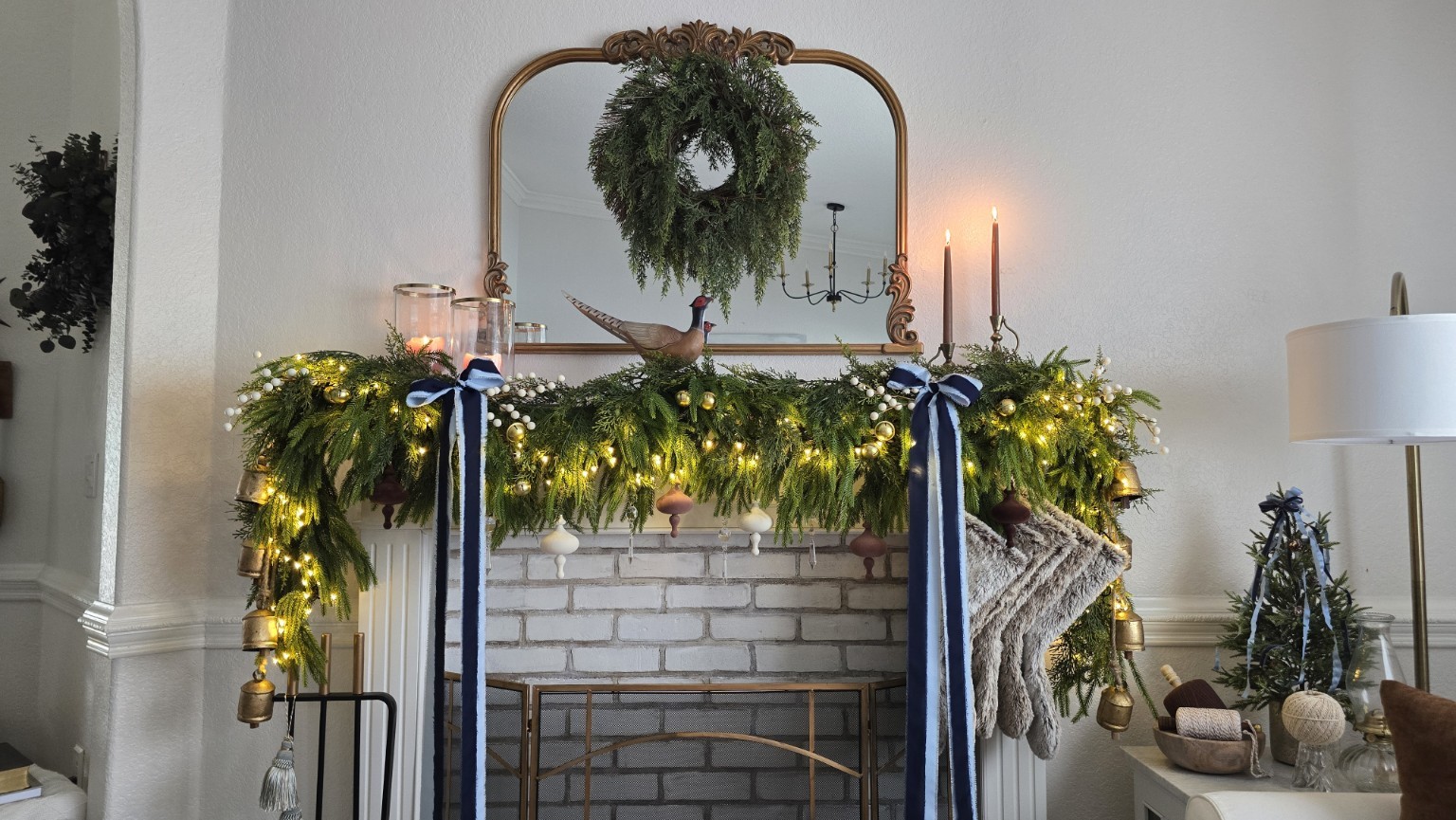
Each garland has a slightly different texture, length and shade of green, and stacking them is what gives me the full, substantial look I want across this fireplace. One garland on its own always feels a little too thin here. Four layered together create that heavier, traditional Christmas look that can hold its own beneath my large gold mirror.
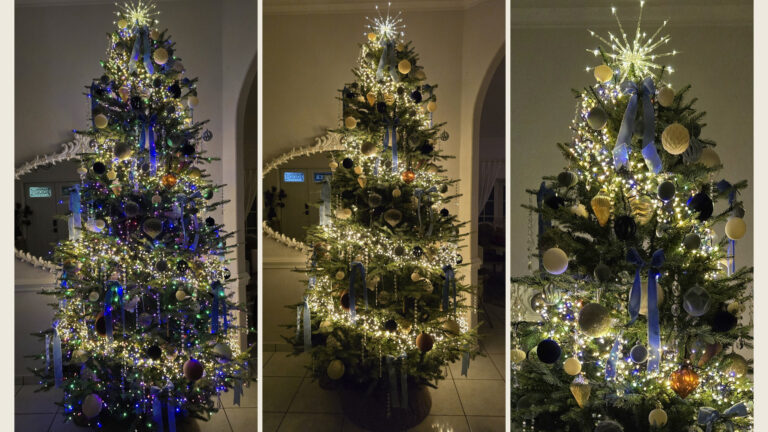
This year, I also wanted the mantel to feel slightly different from my Cinderella-inspired Christmas tree.
The tree is the lighter, more romantic side of the room. The mantel is darker, more tailored and more old-world—still connected to the same Christmas story, just without repeating everything happening on the tree.
The result feels collected rather than matched.
Why I Use Faux Christmas Garland
All four garlands are faux.
That isn’t because I dislike real greenery. I love the look of it. I simply can’t comfortably use real Christmas trees, pine and similar greenery indoors, especially once they begin drying out. The mold spores triggers a respiratory allergy.
So faux greenery isn’t really a compromise in my house. It’s what works.
And after using it this way for several years, I’ve realized that faux greenery can look much better when I stop expecting one garland to do everything.
Instead, I mix several styles together.
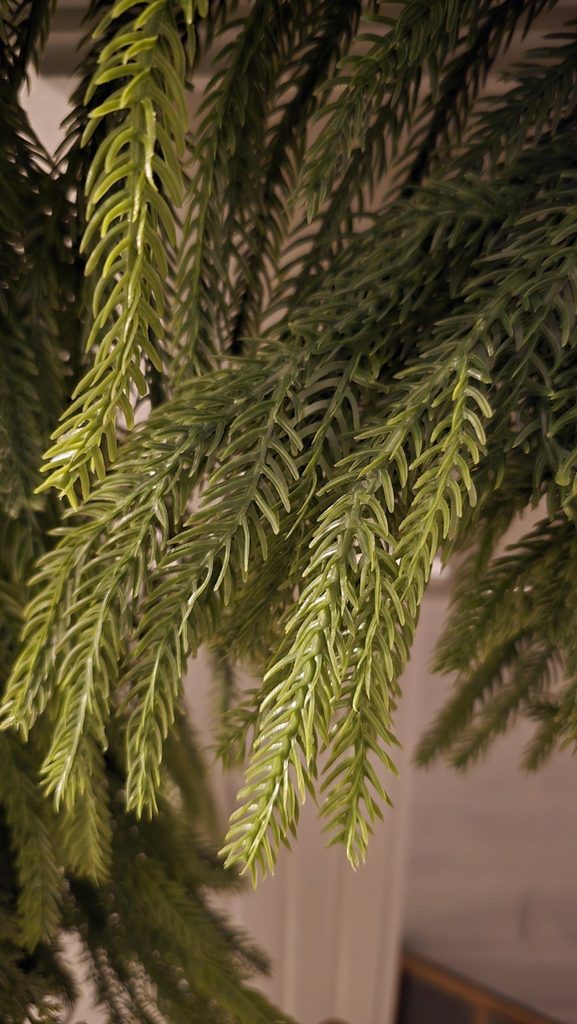
Two of mine are similar Norfolk-style garlands, although they aren’t identical. One is longer—around nine feet—while the other is closer to six feet. Their shades of green are slightly different, too.
The other garlands have finer cedar- or cypress-like branches.
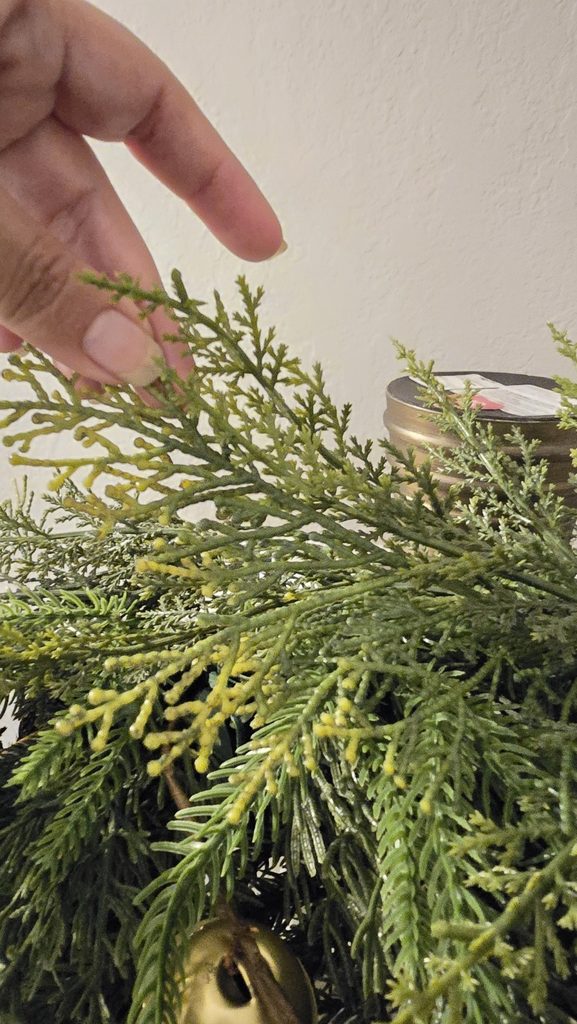
That variation is exactly what I want.
Some of the greenery hangs softly and creates movement. Other pieces are finer and more structured. When they’re layered together, one fills the gaps left by another, and the different branch shapes keep the finished garland from looking like one thick piece of molded greenery.
I don’t worry about making every strand match.
I actually think it looks better when they don’t.
I Layer the Greenery Straight Across the Mantel
My mantel is roughly 63 inches wide, and I wanted the greenery to feel traditional.
I wasn’t looking for an asymmetrical cascade or a dramatic swag dipping through the center. I wanted a full line of greenery running across the fireplace with the extra length falling naturally down both sides.
It’s the kind of Christmas look I associate with older homes, traditional decorating and that slightly Ralph Lauren feeling of rich greenery, warm metal, candlelight and collected objects.
So instead of carefully shaping one garland, I stacked all four.
I laid them across the mantel, adjusted the branches until the different textures mixed together, and allowed the longer pieces to hang down the sides.
The goal wasn’t perfect symmetry.
It was density.
With such a large mirror above the fireplace, a thin garland would disappear. The heavier greenery gives the fireplace enough visual weight to balance everything above it.
To keep the garlands together, I tied them in a few places with thin green velvet ribbon.
The green disappears into the foliage, so you don’t notice it once everything is finished. I much prefer that to having visible ties breaking up the greenery.
I then secured the garland to the mantel with removable hooks.
Nothing about the construction is particularly complicated. Most of the effect comes from using enough greenery and taking a few minutes to separate, fluff and reposition the individual branches.
Warm White Lights Change Everything at Night
Once the greenery was in place, I added warm white lights.
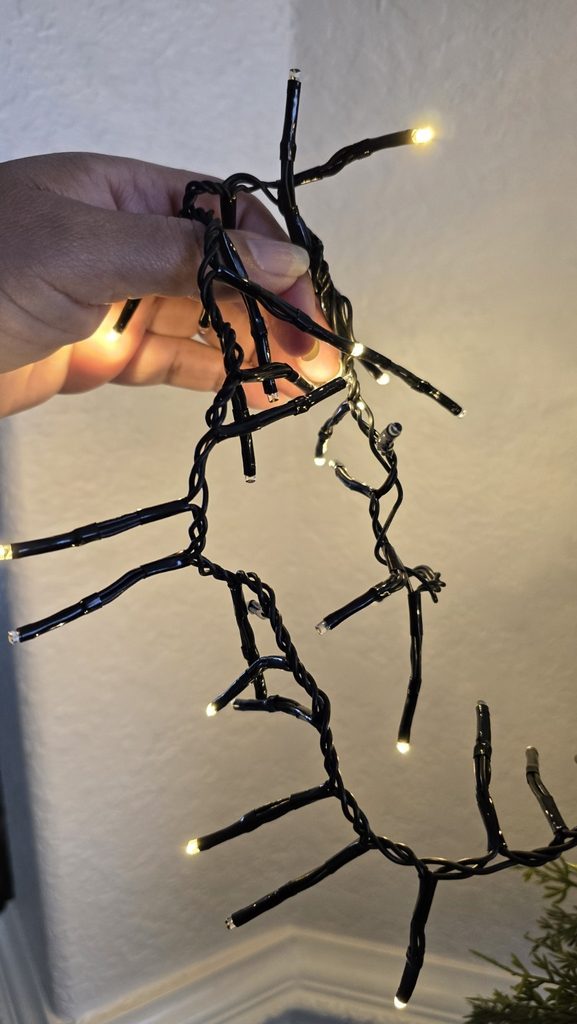
Mine are plug-in lights with several settings and a remote, but I keep the lighting simple. I don’t need the garland flashing or competing with the rest of the room.
I want glow.
The warm lights disappear into the greenery during the day, then completely change the fireplace once evening comes.
They reflect against the gold mirror, glass hurricanes, brass details and ornaments and make all four layers of greenery look even deeper.
The greenery gave the mantel volume.
The lights gave it atmosphere.
Then I Added Contrast Instead of More Greenery
Once the greenery and lights were finished, I started adding the decorative layers.
This is where I had to be careful.
The garland was already very full, so adding too many ornaments would have hidden the texture I had spent all that time building.
I added white berry stems in a few places instead.
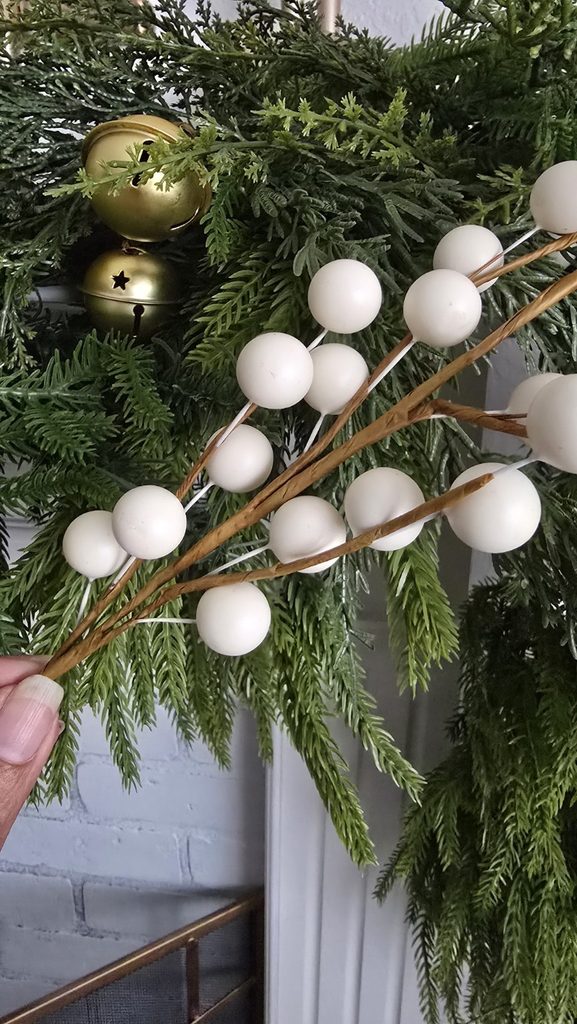
The berries break up all the green without making the mantel look heavily decorated. Their shape also gives the eye somewhere to stop among all the fine evergreen branches.
I tucked small gold bells through the greenery for warmth and a little shine.
Then I added several elongated finial ornaments in soft white and muted brown tones.
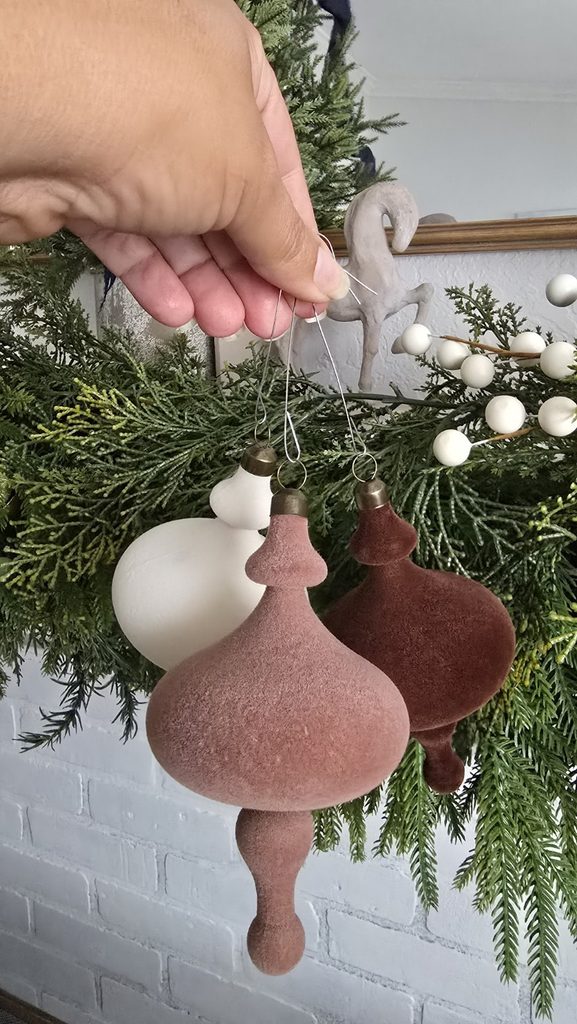
Those were important because they introduce another shape without adding another color story. They hang beneath the greenery and help pull the eye downward toward the fireplace instead of leaving everything sitting in one heavy horizontal line.
The colors also work with the warmer browns, brass and cognac tones I wanted for this side of the room.
Navy Ribbon Connects the Mantel to the Tree
The ribbon is where I allowed more of the Cinderella palette to come through.
I used long navy ribbon layered with pale blue.
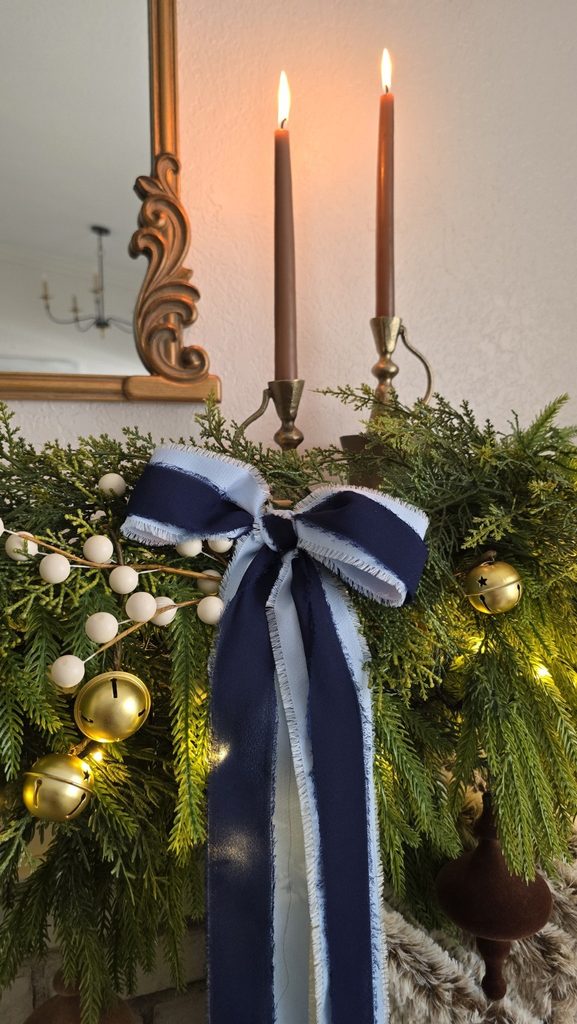
The navy is much deeper than most of the blue on the Christmas tree, so the mantel still has its own identity. The lighter blue edge keeps the ribbon from becoming too severe and quietly connects it to the softer blues elsewhere in the room.
I didn’t make small, perfect bows.
I wanted the ribbon to feel loose and long enough to become part of the architecture of the fireplace.
The tails fall well below the mantel, which again helps break up that strong horizontal line of greenery.
It gives the fireplace a little drama without requiring more ornaments.
The Stockings Add Another Layer of Texture
My stockings are a soft faux fur in a neutral brown and cream.
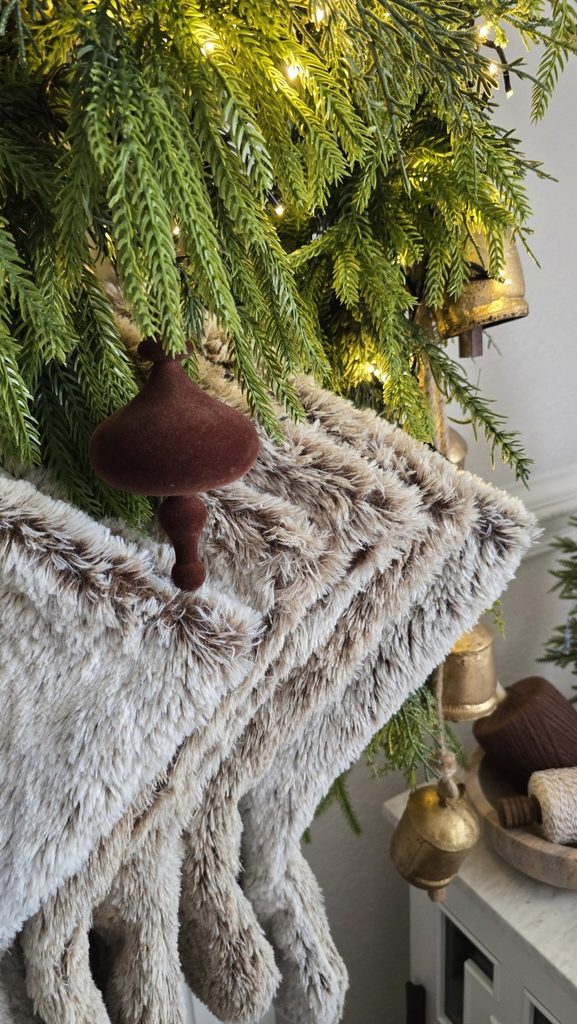
Against all of the evergreen, ribbon and metal, they add a completely different texture.
That’s one of the things I think makes a layered Christmas mantel work: not everything needs to be another ornament.
Greenery, velvet-like finishes, fur, glass, brass, ribbon and candlelight all behave differently.
That variation creates richness without requiring a large number of objects.
I also hung larger aged-gold bells along the sides of the garland. They have a more worn, old-fashioned finish than the smaller gold bells tucked through the greenery, which keeps the mantel from looking too polished or new.
The Gold Mirror Stayed, but I Added a Wreath
The large gold mirror above the mantel always stays.
It already gives the fireplace the formality I want, and I love the way Christmas lights and candles reflect in it.
This year I added a loose evergreen wreath directly over the mirror.
I didn’t heavily decorate the wreath.
The greenery itself was enough.
Because the wreath is airy and imperfect, you can still see the carved detail of the mirror around it. I didn’t want to cover one of the most beautiful architectural-looking pieces in the room just because it was Christmas.
The wreath simply gives the mirror another layer.
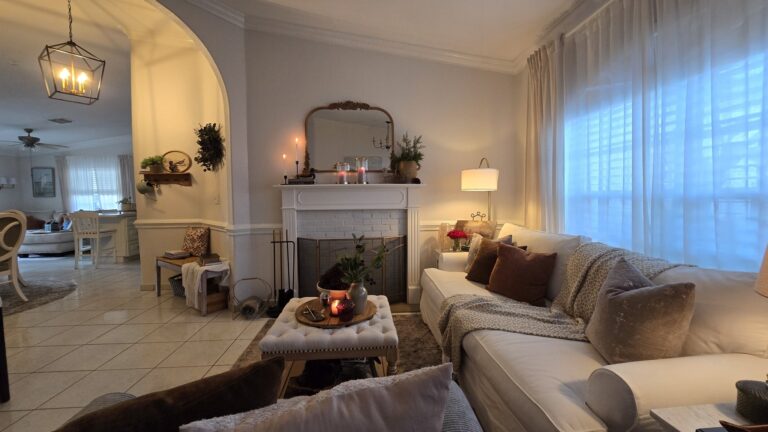
And depending on where you’re standing, you can see my Cinderella Christmas tree reflected behind it.
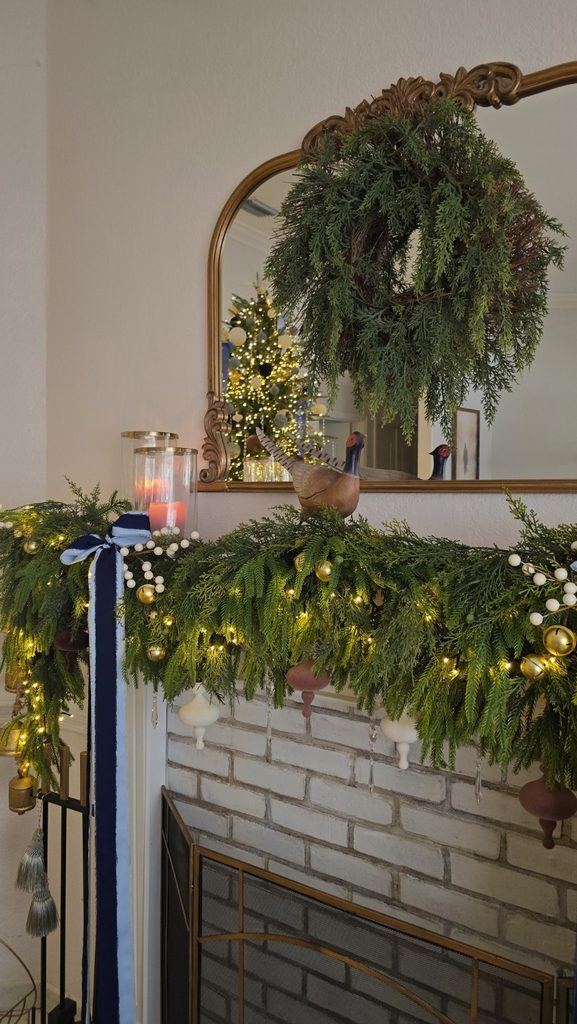
That reflection is probably one of my favorite parts.
The tree and mantel don’t match, but seeing one through the other makes it obvious that they belong in the same room.
I Used a Pheasant Instead of More Traditional Christmas Figures
The pheasant became the central object on the mantel.
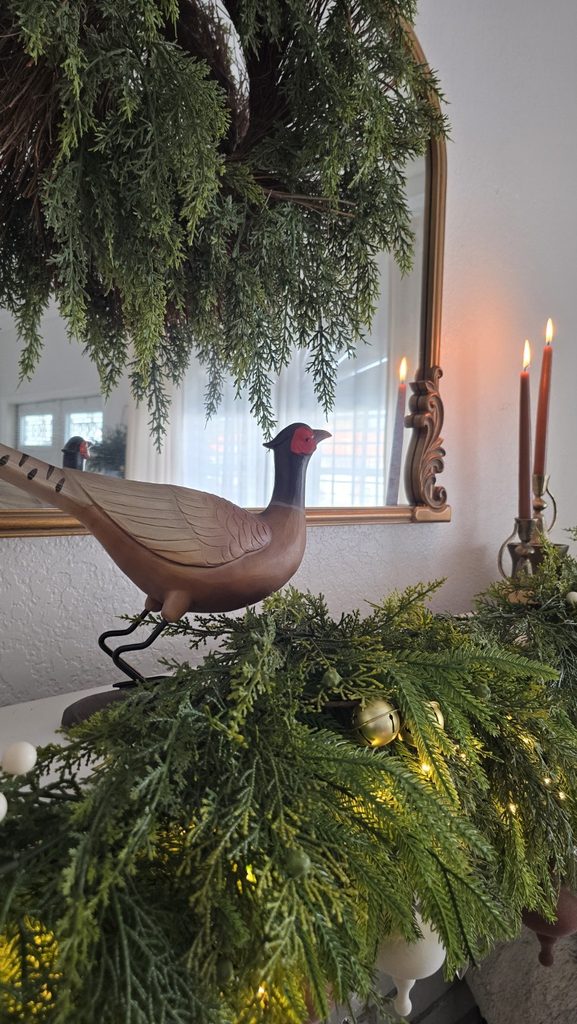
It gives me the old-world feeling I wanted without looking overtly Christmas-themed.
That’s an important distinction for me.
I didn’t want every object on the fireplace to be a Christmas decoration. I wanted some of the pieces to simply feel appropriate for Christmas because of their material, color or character.
The pheasant has that traditional English-country feeling and works naturally with the deep greenery, brown ornaments, brass and candlelight.
It also keeps the center of the mantel from becoming overly formal.
There is something slightly unexpected about it.
Candlelight Finished the Look
On the right side, I used brass candlesticks with warm brown taper candles.
On the opposite side, glass hurricanes give me another source of candlelight and a completely different material.
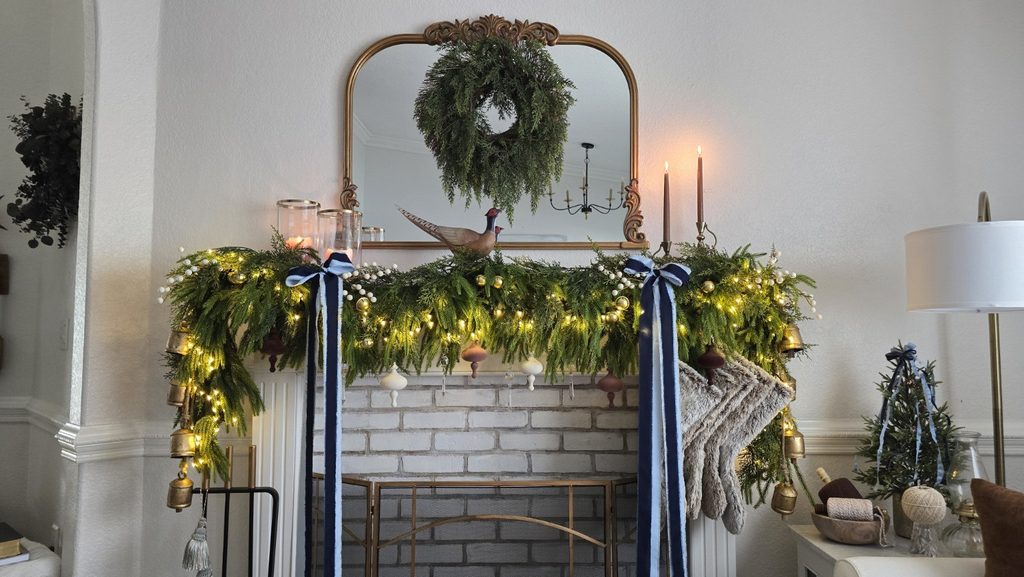
I didn’t need a row of candlesticks across the entire mantel, like last years mantel.
There was already enough happening.
Instead, I let a few taller pieces create height above the greenery while leaving some open space around the pheasant and wreath.
That breathing room matters.
A mantel can go from layered to cluttered very quickly, especially when the garland itself is already this full.
At some point, adding more doesn’t make it richer.
It just makes it busier.
The Mantel Doesn’t Need to Copy the Christmas Tree
This was probably the most important decision I made about the fireplace this year.
I didn’t want the mantel to simply repeat the tree.
My Cinderella-inspired Christmas tree already carries the lighter, more romantic side of the story, with pale blue, navy, glass, pearl and warm lights.
If I had repeated every one of those elements across the fireplace, the room would have started to feel too coordinated.
Instead, I used the mantel to introduce the other side of the story.
Deeper navy.
Brown and cognac.
Aged gold.
Heavy greenery.
Fur.
Candlelight.
Traditional shapes.
The connection is still there, but it isn’t literal.
If the tree feels like Cinderella, the mantel feels more like the world around her—the ballroom, the prince, the castle and the candlelight.
One is lighter and more romantic.
The other is richer and more grounded.
What Makes the Layered Garland Work
If you wanted to recreate this kind of mantel, you wouldn’t need the exact same garlands or decorations I used.
The method matters more than the individual pieces.
Start with enough greenery to create real volume.
Mix at least two different branch textures instead of using several identical garlands.
Let some of the greenery hang naturally rather than shaping every branch perfectly.
Add warm light deep inside the greenery.
Then bring in contrast slowly—berries, bells, ribbon, ornaments or whatever fits your own Christmas palette.
After that, stop and look at it before adding anything else.
I think that last part matters as much as the layering.
A full garland needs fewer decorations than you think.
I wanted mine to feel abundant, old-world and collected, but I still wanted to see the greenery underneath everything.
That’s where I stopped.
And that’s probably why the finished mantel feels like it belongs with the Christmas tree without becoming another version of it.
The tree tells one part of the story.
The mantel tells another.
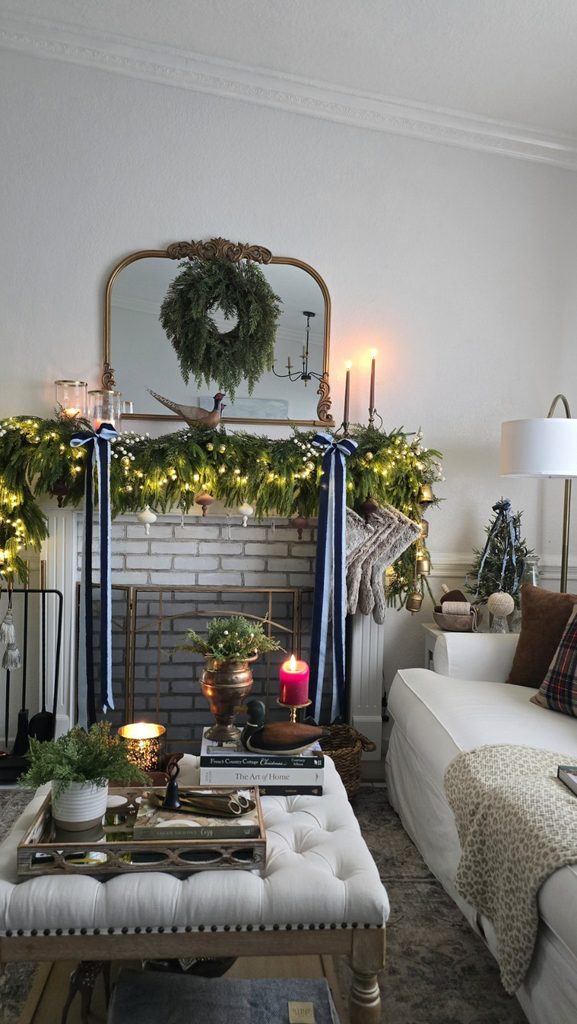
If you’d like to see the other side of this year’s Christmas story, take a look at my Cinderella-Inspired Christmas Tree.
Links
A quick note: the links below are affiliate links, which means I earn a small commission if you buy through them — at no extra cost to you. I only link things I actually use, or the closest match when the exact piece isn’t available online.
Glass hurricane candle holder (similar)
Glass hurricane candle holder (similar)
White and brown berry picks (similar)
Cream and brown flocked finial ornament
Norfolk pine real touch wreath
Join Letters from Lola
New posts and seasonal ideas from my Miami home, delivered to your inbox.